What will happen to Russia’s space "veteran cadres" who want to withdraw from the International Space Station project and make great achievements?
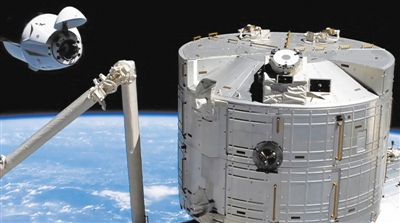
The manned "Dragon" spacecraft with four astronauts docked with the International Space Station, and NASA released some photos. Photo courtesy of vision china
The International Space Station has made outstanding contributions to the rapid development of space science and applications. It has carried out more than 3,600 experiments, published nearly 3,000 high-level papers and published more than 2,200 publications in different fields.
— — Zhang Wei, Director, Application Development Center, Space Application Engineering and Technology Center, Chinese Academy of Sciences
Intern reporter Yu Ziyue
If you have a pair of clairvoyant eyes, you can see through the thick clouds, and there is a huge thing about 400 kilometers above the surface — — International space station. This is the largest space platform in orbit at present, which is jointly built, operated and used by 16 countries. Since its inception, it has been working conscientiously for more than 20 years, making numerous achievements and making a great reputation.
For human beings, manned space technology, space exploration and application and many other fields have been helped by the International Space Station. More importantly, the precious experience of the construction and maintenance of the International Space Station is like a seed, which accumulates strength for the birth of the new space station. Nowadays, the time is ripe for seeds to sprout. On April 21st, Dmitry rogozin, president of the Russian National Space Corporation, announced that Russia wants to build its own space station and strive to launch it in 2030. The launch of the new space station plan also means that the International Space Station is on the verge of "retirement". What contribution has the International Space Station brought to mankind? What will happen after "retirement"?
Multinational cooperation in exploring extraterrestrial space
On Halloween in 1998, two Russian astronauts took a manned spaceship with an American astronaut. After two days of unusual travel, they flew to the International Space Station, which was still in the early stage of construction, and wrote the preface for the international astronauts to stay here.
The International Space Station is one of the areas with the closest cooperation between Russia and the United States, and it is an "ice-breaking" in outer space.
However, it is difficult to build this huge machine that runs through the earth’s near-earth space only by the two countries. Delivery for the International Space Station also includes 11 European Space Agency member countries (France, Germany, Italy, etc.), Japan, Canada and Brazil, a total of 16 countries.
"The International Space Station is a space international cooperation project with the largest scale, the most complex technology and the largest number of countries involved. It has been under construction since November 1998, and has been built by ‘ Dawn ’ The functional cabin is built into 15 cabins of different sizes and will be basically completed by 2010. " Zhang Wei, director of the Application Development Center of the Space Application Engineering and Technology Center of the Chinese Academy of Sciences, said in an interview with the Science and Technology Daily reporter.
Zhang Wei introduced that the overall design of the International Space Station adopts a truss cabin-hanging structure, which is mainly composed of two parts. One part is to connect the Russian Star service module and Dawn function module with the American experimental module of Destiny, the European experimental module of Columbus and the Japanese experimental module of Hope through docking modules and node modules, thus forming the core part of the space station. The other part is that the truss structure is equipped with Canadian teleoperation manipulator system and extravehicular equipment of space station, and four pairs of large solar panels are installed at both ends of the truss.
The 16 countries are dedicated to building, and the 15 th cabin has its own duties. With the mutual dependence and close cooperation of partners, the International Space Station has opened its eager eyes and continuously explored the unknown fields of space technology, extraterrestrial space and scientific frontier.
Make outstanding contributions to space science research
In the field of scientific research, this space laboratory orbiting the earth can be described as brilliant and remarkable. Zhang Wei listed several typical achievements.
It is estimated that 73% of the universe is dark energy, 23% is dark matter and only 4% is visible matter as we know it. The study of dark matter is related to our understanding of the origin and development of the universe. In 2011, the second Alpha Magnetic Spectrometer (AMS— 02) A dark matter detector was placed in the International Space Station. The project attracted 56 institutions from 16 countries and regions to participate. AMS-02 has collected hundreds of billions of cosmic particle data, and the outstanding achievements include: the imbalance of positive and negative matter in the universe; Positrons in cosmic rays may come from dark matter; The age of cosmic rays is about 12 million years; There may be turbulence in the path of cosmic ray propagation. Since then, the new scientific research paradigm represented by the probe has become a new impetus for space science research.
In addition to facilitating the collection of cosmic particles, the International Space Station also has a valuable resource that is difficult to obtain on earth: microgravity. This is precious for us to study the relevant physical laws in microgravity environment.
The Cold Atomic Laboratory is a basic physical facility on the International Space Station, which can cool atoms to ultra-low temperature and study the basic physical properties of atoms in a way that is impossible to exist on earth, such as accurately measuring gravity. Based on this, scientists realize Bose-Einstein condensation in orbit for the first time, which is helpful to solve the most difficult problem in the field of quantum mechanics.
For ordinary people, these tall achievements may be difficult to fully understand. Next, let’s take a look at the relatively "grounded" but equally significant research on the International Space Station.
Earlier on the space shuttle, most astronauts could only spend a week or two in space. After the completion of the International Space Station, astronauts can be active on it for six months or even longer. Living in microgravity for a long time will lead to muscle atrophy and bone loss, and solving this problem is very important for realizing human long-term space survival. At present, scientists have developed daily exercise methods, eating habits and drugs to prevent and treat muscle atrophy and bone loss, which can significantly reduce the occurrence of muscle atrophy and bone loss during astronauts’ stay in the International Space Station, and lay the foundation for ensuring the physical strength and nutrition of astronauts in manned deep space missions.
"The International Space Station has made outstanding contributions to the rapid development of space science and applications. It has carried out more than 3,600 experiments, published nearly 3,000 high-level papers and published more than 2,200 publications in different fields." Zhang Wei told the Science and Technology Daily reporter that his contribution to supporting social and economic development involves many fields such as human health, earth disaster monitoring, popular science education, etc. At the same time, he actively promoted the industrial application of information, materials and medicines, and provided new ideas for the progress and development of ground-related industries.
International Space Station "Retired" or "Re-employed"
The design life of the International Space Station is 10-mdash; Fifteen years. Originally, this outstanding space "veteran cadre" was on the verge of "retirement". However, in 2015, Russia and the United States reached an agreement and signed an agreement to extend the service life of the International Space Station from 2020 to 2024.
Why can the International Space Station "stand by for a long time"? Zhang Wei pointed out that at the beginning of its construction, in order to make full use of this major space facility, it fully considered its long service requirements. At the same time, a series of technical measures have been taken to prevent emergencies, including space station protection scheme to prevent the impact of meteoroids and space debris, equipment testing and maintenance support scheme, etc.
Even so, this behemoth can’t resist the erosion of time after all. In 2020, there was an air leak in the American cabin on the International Space Station. Three astronauts stationed in the cabin were urgently concentrated in the Russian cabin to check the cabin closure pressure and find the source of the air leak. In 2018, the Russian Soyuz spacecraft docked with the International Space Station also found an air leak. At present, these emergencies are still under control.
How long will the International Space Station last? Nobody knows. However, Joel Montalbano, project manager of the International Space Station of the National Aeronautics and Space Administration (NASA) of the United States, is full of confidence in it: "At present, all parties agree that the International Space Station will operate until 2024, and from an engineering standpoint, the space station can last longer. We expect it to run until 2028, and there is no problem. "
Where will the International Space Station go after "retirement"?
Zhang Wei said that at present, the United States hopes to hand over the International Space Station to private companies such as SpaceX or Boeing after 2024. In his view, with the passage of time, spacecraft and equipment will inevitably age. When the safety and reliability of the International Space Station are reduced, especially when the environmental control and life support system cannot work normally and it is difficult to guarantee the life and work of astronauts in space, the International Space Station will have to retire.
"After the International Space Station is retired, in order to avoid becoming space junk, it can be controlled to return to Earth from orbit, and a small amount of debris will fall into the ocean after re-entering the atmosphere and burning." Zhang Wei said.
When a whale falls, everything is born. Even if one day, this diligent space "veteran cadre" will disappear in the ocean with the tragic bath fire, and the value it creates will remain forever on the historical road of human scientific progress, turning into a monument, like a whale falling, catalyzing a new round of space exploration.