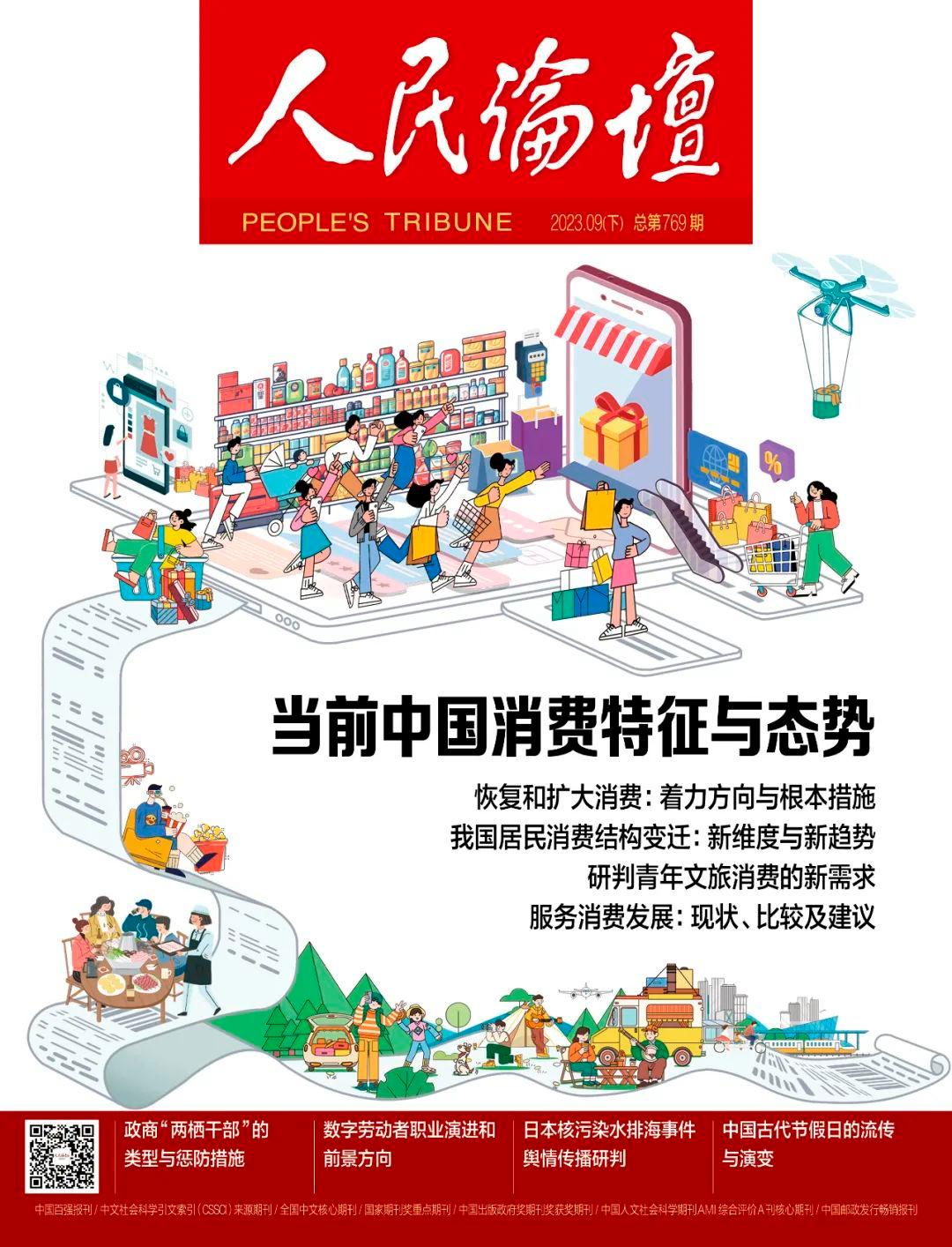
Pay attention to the new issue! Current consumption characteristics and trends in China.

Source | People’s Forum Network-People’s Forum Magazine
Reprint please indicate the source.
Latest planning
Consumption is the main engine of economic growth and the direct embodiment of people’s needs for a better life. At present, the consumer market continues to pick up. Statistics from the National Bureau of Statistics show that in the first and second quarters of 2023, the year-on-year growth rate of per capita consumption expenditure of Chinese residents maintained a positive growth, and the cumulative growth rate in the second quarter reached 7.6%.
China’s consumption recovery is not only a quantitative expansion, but also a qualitative upgrade and structural optimization. On the whole, people’s yearning for a better life has turned from "whether there is" to "whether it is good", showing the characteristics of diversification, multi-level and multi-faceted. From physical goods to life services, from online shopping to offline shopping malls, the trend of digitalization, quality, personalization, diversification and brand upgrading of consumption is increasingly obvious. In this regard, this issue of People’s Forum focuses on special planning.The current consumption characteristics and situation in China have shown new changes.Invite experts and scholars to conduct in-depth discussions.Today, pay close attention to the new phenomenon and new mode of residents’ consumption in the digital economy era, and recommend reading!

From a new perspective, treatConsumption structure of residents
For the consumption structure of residents, academia and policy research departments usually make statistics and analysis from the following three aspects:
First, the purpose of consumptionIncluding subsistence consumption (or subsistence consumption), enjoyment consumption and development consumption. The direction of consumption upgrading is from survival consumption to development consumption and enjoyment consumption. This analytical perspective is based on the hierarchy of human needs, that is, from basic physiological needs and security needs to higher-level needs of socialization, respect and self-worth.
Second, the purpose or behavior of consumption.The National Bureau of Statistics divides residents’ consumption expenditure into eight categories: food, alcohol, tobacco, clothing, housing, daily necessities and services, transportation and communication, education, culture and entertainment, medical care and other supplies and services. The change of the proportion of eight kinds of consumption expenditure in the total consumption of residents usually reflects the change of consumption structure and the trend of consumption upgrading. For example, the consumption proportion of food, alcohol, tobacco and clothing is gradually decreasing, while the consumption proportion of housing, education, culture and entertainment, medical care and so on is gradually increasing. Among them, the proportion of total food expenditure to total personal consumption expenditure is the widely concerned Engel coefficient, which is regarded as one of the main standards to measure the wealth of a family or a country.
Third, the industrial types of consumer goods., including physical consumption and service consumption. Physical consumption corresponds to the primary and secondary industries, including non-durable consumer goods (food, clothing, daily necessities, etc.) and durable consumer goods (household appliances, furniture, automobiles, etc.); Service consumption corresponds to the tertiary industry, including health care, transportation, communication, leisure and culture, education and so on. An important feature of consumption upgrading is the continuous upgrading of durable consumer goods in household consumption, and the proportion of service consumption is increasing.
For the usual analysis of consumer behavior, the above three analysis perspectives dominated by consumer economics are enough. However, in the face of the ever-changing new consumption, we need to add a new perspective to grasp the new dimensions and trends of residents’ consumption structure changes, so as to understand consumption behavior more thoroughly and make relevant policies and business plans on this basis. Based on the insight into the increasingly rich consumer behaviors and complex consumer psychology in recent years, in addition to the above three traditional analytical perspectives, the analysis of consumption structure needs to include at least the following four aspects:
First, the meaning and values of consumption.That is to say, according to the deep motivation and values that affect consumers’ behavior, we can distinguish consumption types, such as self-pleasing consumption, lohas consumption, national tide consumption, advanced consumption, artificial consumption and so on. These consumptions are related to the enjoyment consumption and development consumption in the traditional classification, but the two concepts of "enjoyment" and "development" cannot fully reflect the rich connotation of the new meaning-driven consumption. In addition, in the process of consumption expansion, there are many unhealthy consumption phenomena (such as blind comparison, extreme extravagance, extravagance and waste, etc.). Therefore, to promote high-quality consumption, it is necessary to have a correct and healthy consumption concept to guide and enhance the spiritual realm of consumers, so as to avoid entering the trap of materialism and extreme individualism. Therefore, in the new era of consumption, it is necessary to pay attention to the meaning types of consumption. For the meaning of consumption, we can focus on several aspects: the proportion of self-satisfaction consumption, the proportion of Lohas consumption that pays attention to health and sustainable consumption, the proportion of national consumption that reflects cultural self-confidence, and the proportion of caring consumption (such as poverty alleviation consumption).
Second, the relationship and behavior of consumption.The main body of residents’ consumption is usually individuals, but personal consumption is carried out in a series of important relationships, including the relationship between consumers and producers, the relationship between consumers and the natural environment, and the relationship between consumers and others. In the process of consumption reform, these consumption relations are undergoing significant changes. For example, in the relationship with producers, consumers become co-producers; In the relationship with nature, consumers practice the concept of green consumption and low-carbon consumption; In the relationship with others, consumers gradually show their willingness and actions for gift consumption, shared consumption and circle consumption. Establishing a good consumption relationship is an important feature of high-quality consumption, which is easily overlooked in the traditional consumption structure analysis and needs to be supplemented.
Third, the channels and scenes of consumption.Such as online consumption and offline consumption, domestic consumption and outbound consumption, planned consumption and impromptu consumption. In the new consumption era, new consumption channels and new consumption scenarios have become important consumption growth points, which need special attention. For example, technological changes and supply-side structural reforms have brought about the increasing richness of sales methods and consumer buying behaviors, and a series of e-commerce platforms have evolved, such as shelf e-commerce, social e-commerce, interest e-commerce, instant retail e-commerce, and private e-commerce. If we ignore these changes in consumption channels, we can’t grasp the whole picture of new consumption.
Fourth, the quality structure of consumer goods.The quality grades of consumer goods include low quality (low grade), ordinary quality (middle grade) and high quality (high grade). The traditional consumption structure analysis ignores the grade differences in the same kind of consumption, for example, the same food consumption, which can be simple tea and plain rice, or delicacies; The same is clothing consumption, which can be simple and cheap, or high-end luxury. When studying the consumption structure, if we only make extensive statistics on the proportion of food consumption and clothing consumption and ignore their quality grades, it is obviously insufficient in the high-quality consumption stage of continuous consumption upgrading.

Grasping the new trend of consumption reform from six dimensions
Based on the above seven perspectives, this paper constructs six dimensions to analyze the changes of residents’ consumption structure, hoping to grasp the new trend of China’s consumption reform.
Dimension 1: Daily consumption.The "daily consumption" here basically corresponds to the traditional eight types of consumption expenditure, with the purpose of meeting the daily needs of residents. The change of daily consumption structure is mainly the change of the proportion of eight kinds of consumption expenditure in the total consumption expenditure of residents, that is, the most commonly used index in traditional consumption structure analysis, such as the change of the proportion of food consumption. The structural change trend of daily consumption should be very clear: the proportion of survival consumption decreases, while the proportion of development consumption and enjoyment consumption increases.
Dimension 2: quality and brand consumption.The purpose of quality and brand consumption is to meet the needs of residents’ decent life or superior life, not only to "live" but also to "live a good life". The structural change of "quality consumption" can be characterized by the change of consumption proportion of different quality grades in eight categories of consumption expenditure, such as the change of the respective proportions of low-end, middle-end and high-end foods in food consumption, and even the proportion of organic foods and non-genetically modified foods. Among them, the standard of quality grade may vary from person to person and will evolve with the development of the times.
Brand consumption is closely related to quality consumption, which can be combined in extensive analysis, but it should be discussed separately in more detailed analysis. The structure of "brand consumption" can be analyzed from many aspects. One is the proportion of brands of different grades (which is similar to the structure of "quality consumption"), such as the respective proportions of A-type cars (ordinary compact cars), B-type cars (medium-sized cars) and C-type cars (high-end cars) in automobile consumption; The second is the proportion of popular brands and personalized brands; The third is the proportion of international brands and domestic brands; The fourth is the proportion of traditional brands and cutting-edge brands; Wait a minute. For a long time, the structural change trend of quality and brand consumption is from low to high, that is, from low quality to high quality, low-end brands to high-end brands. However, with the new development concept being deeply rooted in people’s hearts, the current consumer’s concept of quality and brand is changing. For example, under the influence of low-carbon environmental protection concept, consumers may prefer new energy vehicles to traditional luxury gasoline vehicles with a long history.
Dimension 3: "please yourself".In the new consumption era, "self-pleasing consumption" with the purpose of making yourself happy and getting a better life experience has become the attitude of the younger generation. According to the Insight White Paper on Interest Consumption Trends in China in 2022 released by Ai Media Consulting, by 2021, the population of "post-90s" and "post-00s" in China is close to 320 million, which has become a new force in domestic consumption. Among them, more than 60% is to please themselves and enhance happiness as the core of consumption. They buy goods no longer only to meet practical needs, but also pay more attention to the personalized characteristics and additional emotional value of goods. The focus of quality and brand consumption is the characteristics of consumer goods, while the focus of "self-pleasing consumption" is the feelings and experiences of consumers themselves.
"Pleasing oneself for consumption" has become a trend, and it is the embodiment of our country’s social individuality. It should be noted that the rise of individual consciousness and the prevalence of "self-pleasing consumption" do not mean that consumers should deviate from society. In fact, in the minds of many consumers, their happiness is closely linked with family and society. People’s understanding of a better life is not limited to personal material content (such as rich material life), but also includes family relationship content (such as family reunion, family warmth, etc.) and national and social environment content (such as social harmony and stability, democratic civilization, national prosperity, etc.). Moreover, family relationship and national social dimension are more important. In a word, the pursuit of happiness, acquisition and security is behind the "self-pleasing consumption", which is the need of a better life, not only influenced by personal experience, but also by social environment and social relations. In the connotation of a better life corresponding to "self-pleasing consumption", the respective weights of individual prosperity, family happiness and national prosperity are important contents worthy of attention.
Dimension 4: "Co-create consumption".The deep interaction and co-creation between consumers and producers is an important consumption phenomenon in the new consumption era. "Co-creation of consumption" is a two-way trip between consumers and producers or brands. On the one hand, the younger generation of consumers pay more attention to self-expression, have a strong sense of participation and innovation motivation, are not satisfied with being passive consumers, but want to interact with producers or brands through the Internet platform and participate in the process of product creativity, design and marketing; On the other hand, producers or brands pay more and more attention to the relationship with consumers, and actively provide various conveniences to let consumers participate in the whole process of product from creativity, research and development to promotion. Co-creation mode makes consumers no longer passively accept products, but become co-creators of brands. In terms of co-creation with consumers, Xiaomi, Weilai Automobile and other enterprises have accumulated many successful experiences. It can be predicted that with the development of technology and the change of consumption concept, "co-creation consumption" will become more and more popular, and the ways of "co-creation consumption" will become more and more abundant.
Dimension 5: Digital consumption.Digital consumption is a new consumption pattern brought by the rapid development of digital economy, and it is a consumption activity for digital products and services based on new technologies such as Internet, cloud computing and artificial intelligence. In recent years, new formats of digital consumption, such as online shopping, webcasting, digital culture and online medical care, have become increasingly popular, creating many new consumption scenarios, bringing brand-new consumption experiences and changing people’s consumption habits, which has become an important driving force for expanding domestic demand, stabilizing growth and promoting transformation. Relevant statistics show that in 2022, the scale of China’s digital economy reached 50.2 trillion yuan, ranking second in the world, with a nominal increase of 10.3% year-on-year and a proportion of GDP increased to 41.5%.
In February, 2023, the Overall Layout Plan for the Construction of Digital China issued by the Central Committee of the Communist Party of China and the State Council clearly stated that it is necessary to "build an inclusive and convenient digital society". In July 2023, the General Office of the State Council forwarded the National Development and Reform Commission’s Measures for Restoring and Expanding Consumption, and clearly put forward 20 new measures for restoring and expanding consumption, with special emphasis on expanding digital consumption, accelerating the digital transformation of traditional consumption, and promoting the development of digital consumption norms such as e-commerce, live stream economy and online entertainment. It can be predicted that with the strong support and promotion of various policies, China’s digital infrastructure will be more perfect, digital governance and digital services will be more perfect, new formats and new modes of digital consumption will be continuously enriched, and the platform economy will continue to develop healthily, bringing consumers more and better intelligent and humanized consumption experiences. It is worth noting that digital consumption plays an important role in promoting various related consumption activities. For example, the new mode of digital consumption will bring a better consumption experience and expand the space of "pleasing oneself to consume". Digital consumption can also better create a scene of real-time connection and intelligent connection between consumers and producers, and vigorously promote "co-creation of consumption".
Dimension 6: "Harmony and consumption"."Harmony consumption" refers to harmonious, beautiful, healthy and sustainable consumption, which embodies the good state of consumption relationship. "Harmony consumption" includes at least four aspects. First, it is helpful to the harmony of personal physical and mental health and avoid bad consumption; Second, pay attention to family harmony, care for relatives and friends, and pension consumption and parent-child consumption are all related to this; Third, pay attention to the harmony between people and society, and increase the proportion of social consumption and shared consumption; Fourth, it reflects the harmony between man and nature, and the proportion of green consumption and low-carbon consumption has increased. In the process of promoting high-quality consumption, the proportion of "Hemei consumption" will be higher and higher.


How to optimize the consumption structure of residents?
The above six dimensions provide a more systematic framework for us to analyze the changes of residents’ consumption structure. At the same time, taking these dimensions and corresponding development trends as a reference, we can more clearly see the shortcomings and problems existing in China’s current residents’ consumption, such as there are still some obstacles and hidden barriers in the consumption field, the legal environment and service foundation of assured consumption need to be improved, the service awareness and service ability of enterprises need to be improved urgently, the supporting measures for new consumption such as digital consumption need to be improved, and some consumption concepts need to be updated. Therefore,To promote the high-quality development of consumption, we should not only exert our strength from the economic aspect, but also take the overall concept and systematic thinking as the basis, make various measures and take measures simultaneously, build a good ecology, and consolidate the foundation of consumption upgrading and consumption structure optimization.
In the social aspect, we should advocate the new fashion of "beauty consumption", establish a scientific "consumption upgrading concept" that conforms to the new development concept, and adhere to the "double standards" of high-quality consumption upgrading: first, we should meet the needs of consumers for a better life (rather than unhealthy and vulgar needs), and second, we should meet the requirements of the new development concept (innovation, coordination, green, openness and sharing) and make new development. The "double standard" of high-quality consumption upgrading means taking into account the needs of individuals for a better life and the desire of all people to build a better society. In terms of consumers, guide them to establish a healthy consumption concept and enhance the consumption realm. Create conditions for consumers to have more opportunities to participate and stronger co-creation ability, and improve the co-creation efficiency of consumers, producers and brands. In terms of enterprises, on the one hand, we should advocate long-term doctrine, put an end to short-term behaviors of quick success and misleading consumers, on the other hand, we should actively take advantage of the opportunity of consumption upgrading to make up for shortcomings such as insufficient service capacity, optimize the consumption ecology from the supply side, and promote the upgrading of consumption. In addition, relevant government departments can go beyond the traditional economic management and consumption management mode, fully grasp the new dimensions and trends of consumption structure changes, carry out strategic changes and governance model innovation based on brand-new cognition, introduce and implement new policies and measures in time, and create a good ecology to promote high-quality consumption.
The above is slightly abridgedFrom September of People’s Forum magazine (below)Original title | Changes in China’s residents’ consumption structure: new dimensions and new trends
Author | Peng Siqing, Professor and Doctoral Supervisor of Guanghua School of Management, Peking University
Dong Bin, a reporter from CCTV News Channel, also contributed to this article.
New Media Editor | Wang SinanOriginal Editor | Li Danni
Welcome to pay attention to ↓↓

Reporting/feedback