Fighters on the Korean peninsula gather! "Death Swan" visits again to attract attention.
Cctv newsAt present, there are many fighters on the Korean peninsula. Today, the United States and South Korea’s "vigilance ace" joint military exercise entered the third day, and the American B-1B bomber formation known as the "death swan" also visited the Korean peninsula again, which attracted the attention of all parties. On the 6th, Yonhap News Agency quoted South Korean military sources as saying that the formation of American B-1B bombers deployed at Anderson Air Force Base in Guam participated in the annual large-scale joint air exercise between the United States and South Korea on the same day. The US B-1B bomber formation will carry out bombing exercises over the peninsula, and the US-South Korea air force fighters will escort it. Yonhap News Agency reported that the formation of B-1B was intended to exert extreme pressure on North Korea.
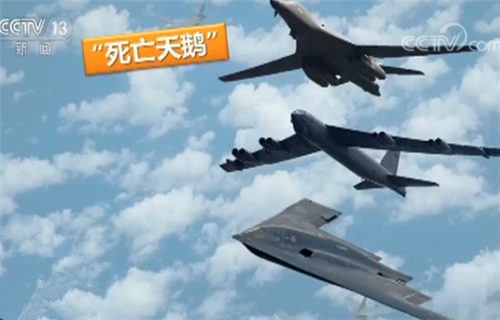
News link: "Frequent visitor" B-1B bomber over the peninsula
The U.S. B-1B bomber is known as the "swan of death", and it is also known as the three strategic bombers of the United States together with B-52 and B-2.
Americans like to call it "lancer" because the B-1B bomber has the ability of "carpet bombing" and is extremely destructive. And taking off from Guam, you can reach the peninsula to participate in the battle in two hours. It is precisely because of this that every time there is a figure of B-1B over the peninsula, all parties are nervous.
When it comes to the formation of B-1B fighters, it can be regarded as a frequent visitor over the Korean peninsula. Beginning in August 2016, the US Pacific Command announced that the US military sent a squadron of B-1B "Lancer" bombers to the Asia-Pacific region for the first time in ten years and deployed it at Anderson Air Force Base in Guam to replace the B-52 bomber. At that time, the US media analyzed that this officially kicked off the deployment of the US military B-1B in the Asia-Pacific region.
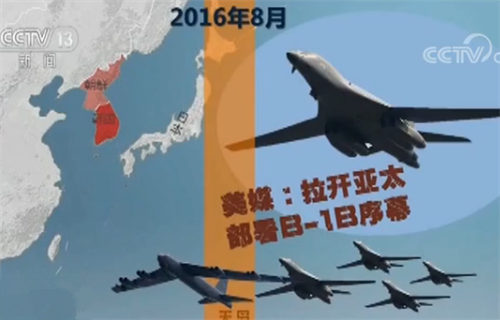
Subsequently, in September 2016, two US B-1B bombers officially flew to Wushan Air Force Base, Gyeonggi Province, South Korea, just after the North Korean side conducted its fifth nuclear test. Since then, the United States and its allies South Korea and Japan have conducted several military exercises in the Asia-Pacific region, in which the B-1B fighter formation also participated. In May this year, after the North Korean side launched a series of Scud missiles, B-1B flew to the peninsula. In June this year, after the death of Warmbier, an American college student released by North Korea, the US military also dispatched B-1B, but then responded that it was only routine training; In July this year, the US Army B-1B and the Korean Air Force battle formation conducted live-fire exercises; In August, B-1B once again flew to the peninsula and two KF-16 fighters of the Korean Army for flight exercises. In October, B-1B took off from Guam again and conducted flight training near the Sea of Japan with two F-15J fighters of Japan Air Self-Defense Force and two F-15K fighters of South Korea Air Force.
The number of American "lancers" in service is about 77.
It can be seen that the "lancer" of the US military is a guest on the peninsula, which can be described as "action every month", but what are the advantages of such a high-profile B-1B bomber?
B-1B bomber is a long-range, multi-purpose supersonic strategic bomber with variable swept wings, which is developed by Lakwer Aircraft Company of the United States. Americans call it "lancer". At present, the number of US Air Forces in service is about 77.
The B-1B bomber has a maximum speed of Mach 1.25 and a cruising capacity of 12,000 kilometers, and can perform intercontinental strategic bombing missions. The cabin of B-1B can carry 34 tons of ammunition, in addition to 26 tons of ammunition. In contrast, in the American strategic bomber family, B-2 can carry 16 air-to-ground missiles outside the joint defense zone, B-52 can only carry 12, and B-1B can carry 24, which shows its ability.
However, the radar reflection area of such a behemoth is only 0.75 square meters; In contrast, the radar reflection area of the B-52 is as high as 100 square meters, while the radar reflection area of most fighters is more than 2 square meters.
The B-1B is equipped with terrain tracking radar, which can keep the plane at a height of about 60 meters from the ground under complicated terrain conditions, so as to achieve ultra-low altitude and high-speed penetration, and it can throw all the ammunition in a few seconds, and then quickly leave the war zone to achieve strong attack suddenness.